
Wooden spiral staircases
A complete guide to making the most of your space with style
Spiral staircases are an architectural solution increasingly used in homes where space is limited or where a decorative element with its own personality is sought. Especially in interiors, wooden spiral staircases stand out for their ability to combine functionality, warmth and design in a compact structure.
In this complete guide you will learn what spiral staircases are, when it is worth installing them, what materials work best depending on the use, what sizes are really comfortable and how to choose the right model for your home. In addition, we will solve the most common doubts so you can make an informed decision, without costly mistakes.
Index
- What are spiral staircases
- Advantages of spiral staircases
- Types of spiral staircases according to material and use
- Most commonly used materials
- How to choose a spiral staircase without making a mistake
- Recommended measurements for a comfortable spiral staircase
- Installation and maintenance
- Frequently asked questions about spiral staircases
What are spiral staircases
Spiral staircases are helical structures that rotate around a central axis, allowing two levels to be connected with minimal space occupation. Unlike straight or L-shaped stairs, their circular design considerably reduces the surface area required, making them an ideal choice for small homes, duplexes, attics and lofts.
Beyond its practical function, this type of staircase has established itself as a decorative element in its own right. In particular, wooden spiral staircases bring a sense of warmth and naturalness that is difficult to match with other materials, integrating easily into classic, rustic or contemporary interiors.
Advantages of spiral staircases
Choosing a spiral staircase is not only a question of aesthetics. Among its main advantages are the following:
- Real space saving, occupying up to 60% less than a conventional ladder.
- Flexibility of location, even in areas where a traditional staircase would be unfeasible.
- High decorative value, with designs ranging from classic to minimalist.
- Possibility of customization, both in materials and in dimensions, finishes and railings.
However, they are not a universal solution. In homes with heavy traffic or with specific accessibility needs, it is advisable to consider other alternatives before deciding.
Types of spiral staircases according to material and use
Wooden spiral staircases
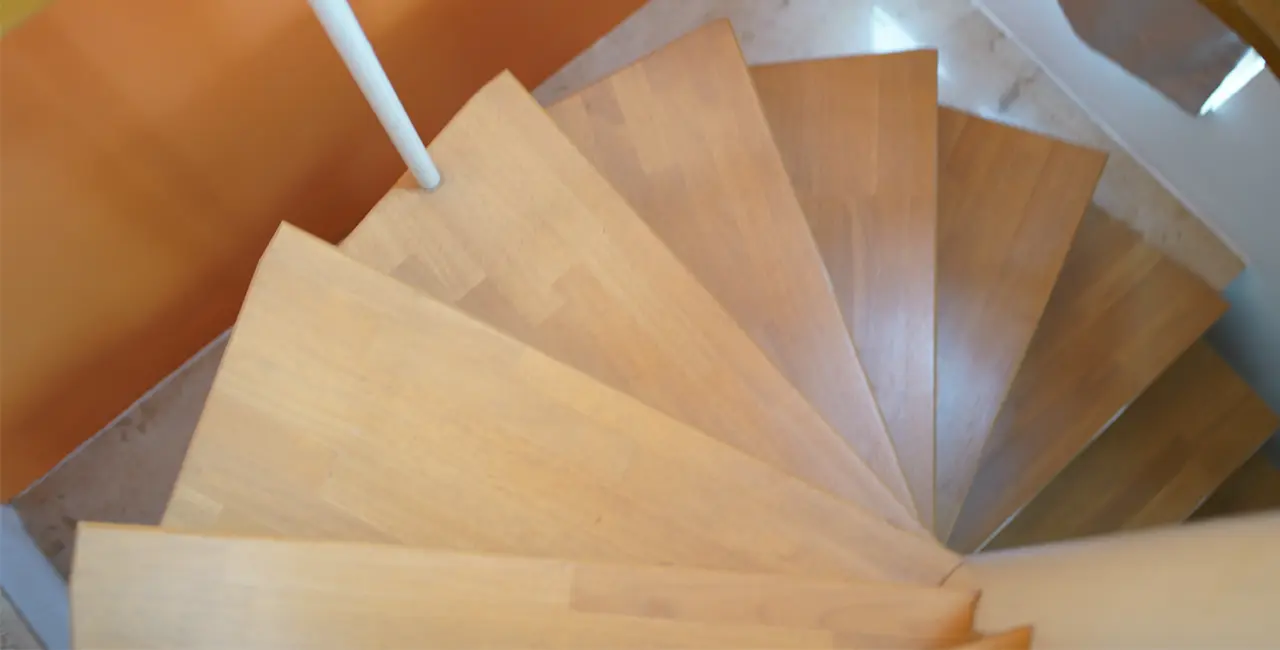
Wooden stairs are the most common choice for interiors. They offer visual warmth, good integration in family homes and multiple combination possibilities with metal or glass railings.
Metal spiral staircases
They are mainly used in industrial or modern style spaces and outdoors, provided that the metal is properly treated to resist weathering.
Mixed models
They combine wood and metal to achieve a balance between structural strength and aesthetics, resulting in contemporary and highly versatile designs.
Most commonly used materials
The choice of material directly influences the durability, maintenance and final appearance of the staircase:
- Wood: ideal for cozy interiors; requires periodic maintenance.
- Stainless steel: modern look and high strength with low maintenance.
- Iron: robust and perfect for rustic or industrial styles.
- Glass: provides luminosity and visual lightness, although it requires frequent cleaning.
- Galvanized metal: the best choice for exteriors due to its resistance to corrosion.
How to choose a spiral staircase without making a mistake
- Available space: accurately measure the diameter and height between plants.
- Frequency of use: a ladder for occasional use is not the same as a ladder for daily use.
- Safety: non-slip steps, firm handrail and adjustable height.
- Style of the environment: the staircase should be integrated with the overall design of the house.
When the space is complex or you are looking for a fully integrated result in the house, it is best to opt for a spiral staircase spiral staircase made to measureadapted to both the actual dimensions and the style of the environment.
For models, materials and customized solutions, please visit our product page.
Recommended measurements for a comfortable spiral staircase
- Step height: 18-22 cm
- Useful width: 60-80 cm
- Total diameter: 130-200 cm
- Swivel angle: 360° or 450°, depending on design
These measurements are indicative and should always be adapted to the current
regulations and the actual use of the staircase.
Installation and maintenance
Spiral staircases require little maintenance, but it is advisable to carry out periodic inspections to check the stability of the central axis, the fastening of the steps and the condition of the handrail.
On wooden spiral staircases, gentle cleaning and occasional re-varnishing helps to preserve the finish and prolong the life of the staircase.
Frequently asked questions about spiral staircases
What is the minimum diameter of a spiral staircase?
A minimum diameter of 120 cm is recommended to ensure comfort and safety.
Are spiral staircases safe?
Yes, provided they have non-slip treads, a firm handrail and proper installation.
Can spiral staircases be installed outdoors?
Yes, provided they are made of resistant materials such as galvanized metal or treated steel.
Are spiral staircases comfortable for everyday use?
With an adequate diameter and wide rungs, they can be comfortable even with frequent use.
What material is best for a spiral staircase?
It depends on the environment: wood for warm interiors, steel for modern styles and galvanized metal for exteriors.
Can spiral staircases be customized?
Yes, it is possible to adapt materials, colors, railings and dimensions according to the available space.
Do wooden spiral staircases require maintenance?
Only basic maintenance: periodic inspections and regular cleaning. On wooden models, occasional repainting helps to preserve their original appearance.