
Floating wooden stairs
Modern design, safety, and how to choose them correctly
Floating wooden staircases have become one of the most sought-after solutions in contemporary interior design. Their light aesthetic and ability to integrate into different architectural styles allow for a complete transformation of a space, making it feel more open and bright.
Within the range of wooden staircases, this type of solution stands out for its balance between design and technique, as it combines a minimalist appearance with a carefully calculated structure.
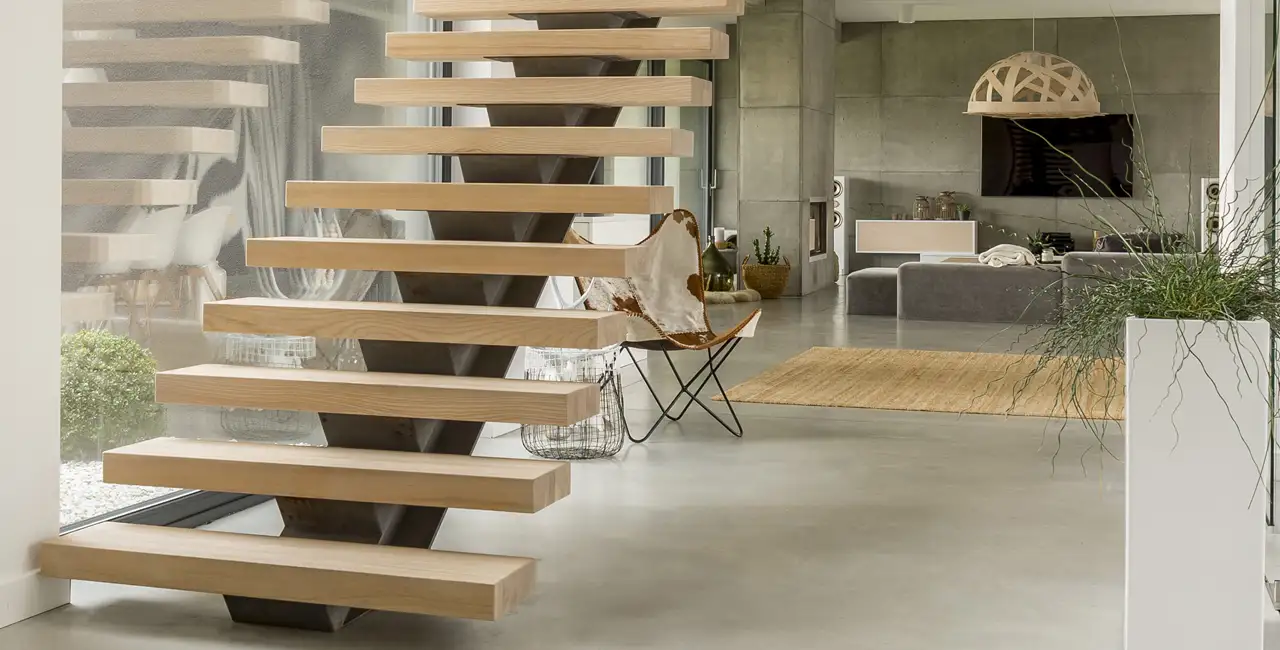
Table of Contents
- What are floating wooden stairs?
- Advantages of floating stairs
- How its structure works
- Materials and behavior of the steps
- Safety and regulations
- When to choose a floating staircase
- Frequently Asked Questions
- Conclusion
What are floating wooden stairs?
Floating staircases are those in which the treads appear to be suspended in the air, without a conventional visible structure such as stringers or continuous supports. This visual effect is achieved through concealed anchoring systems that allow each tread to be fixed independently.
In reality, behind that visual lightness lies a precise technical solution, usually based on anchoring to load-bearing walls or internal metal structures that remain hidden. This type of design is common in modern wooden staircase projects, where the aim is to reduce the visual impact of the structural elements.
Advantages of floating stairs
- They allow for a greater sense of spaciousness in the space.
- Se integran fácilmente en interiores modernos y minimalistas.
- They facilitate the entry of light, especially in open spaces.
- They offer a clean and contemporary design.
Beyond its aesthetic appeal, this type of staircase helps improve the perception of space, as it eliminates visual barriers and allows for a more fluid reading of the surroundings.
How its structure works
Although they appear to be suspended, floating staircases require a robust structural system. Each step acts as an independent element that must withstand point loads without deforming.
In most cases, the steps are fixed to a load-bearing wall using concealed metal anchors. In other situations, internal steel structures are used to distribute the loads evenly.
Structural calculations are essential to ensure safety and prevent movement during use. For this reason, these types of staircases must be designed and manufactured by specialized professionals.
Materials and behavior of the steps
The treads are the most important element in a floating staircase, as they must support loads without visible support. This requires careful selection of materials and precise control of their manufacture.
In practice, woods like oak, beech, and walnut offer good structural performance and high resistance to continuous use. Oak, in particular, is one of the most widely used options due to its durability and stability.
In many cases, glued laminated treads are used, as they offer greater dimensional stability than solid wood. This characteristic is especially important in floating systems, where any deformation can affect the entire structure.
If you want to delve deeper into this topic, you can consult our guide on stair treads, where we analyze the different formats and solutions available.
In renovations, it is also possible to achieve a similar visual effect by cladding stairs, a simpler solution when the base structure already exists.
Safety and regulations
One of the most important aspects of this type of staircase is ensuring safety. Despite their lightweight appearance, they must comply with established structural and regulatory requirements.
This involves ensuring the strength of the anchors, controlling the spacing between steps and, in many cases, incorporating protective systems such as railings.
In this sense, it is common to combine these solutions with wooden stair railings, which allow safety to be maintained without compromising the design.
When to choose a floating staircase
Floating staircases are especially suitable for homes where interior design is a key consideration. They work very well in open spaces, in renovations where the aim is to lighten the existing structure, or in contemporary projects with a minimalist aesthetic.
However, its feasibility depends largely on the structural conditions of the space. It is essential to have a suitable load-bearing wall or a technical solution that guarantees the correct attachment of the steps.
In floating staircases, the structural system and tread thickness can significantly influence the overall cost, especially when using custom solutions or special formats. These factors determine the price of wooden treads in contemporary projects.
Frequently asked questions about floating staircases
Are floating staircases safe?
Yes, provided they are properly designed and executed with suitable anchoring systems and quality materials.
Can they be installed in any home?
Not always. Adequate structural support is necessary to securely fix the steps.
Which wood is most recommended?
Oak is one of the most commonly used options due to its durability, although beech and walnut are also used depending on the design.
Can they be combined with glass?
Yes, it is a very common solution to reinforce security without losing visual lightness.
Conclusion
Of all the possible stair configurations, floating wooden stairs represent an advanced solution from both a technical and aesthetic point of view. Their proper execution requires precise design, controlled manufacturing, and professional installation.
When properly designed, they allow for a complete transformation of the space, providing visual lightness, modernity, and a coherent integration with the architectural environment.
In this type of staircase, the treads not only serve a structural function but also become the focal point of the design. For this reason, the choice of material, format, and finish is especially important. If you are considering this type of solution, you can explore our options for wooden treads, with different configurations adapted to floating staircase projects.