
How to build a wooden staircase step by step
Manufacturing process
When someone looks at a finished staircase, they usually notice the design, the beauty of the wood, or how well it fits with the house. However, the entire process begins long before the first piece is cut. Behind every staircase lies a technical process involving planning, material selection, precision machining, quality control, and a multitude of decisions that are barely visible once it’s installed.
As manufacturers of wooden staircases, we know that a good staircase depends on more than just using quality wood. The difference lies in how each project is studied, how each component is manufactured, and how the entire process is controlled to obtain a piece capable of remaining stable, safe, and functional for decades.
In this article, we want to show you how we manufacture a wooden staircase step by step, explaining everything that is usually kept hidden from the client. Because building a staircase is not just about machining wood, but about transforming an architectural project into a solution perfectly tailored to each home.
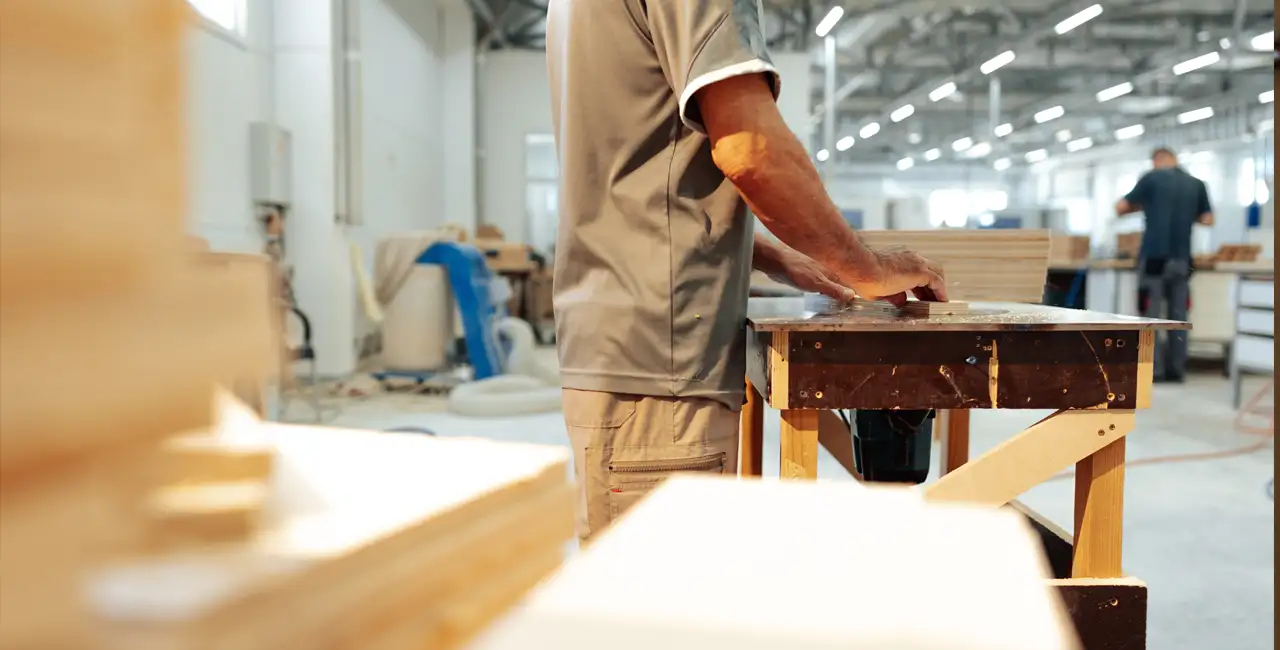
Table of Contents
- Each staircase begins as a unique project
- Technical study and taking of measurements
- Selecting the right wood
- Technical design using CAD
- CNC machining and manufacturing of parts
- The artisanal work done in the workshop
- Assembly and adjustment test
- What happens in the workshop that the customer usually never sees
- To be continued…
Each staircase begins as a unique project
One of the biggest differences between industrial manufacturing and truly custom-made staircases is that no staircase ever begins directly in the workshop machinery. Before manufacturing a single piece, it’s essential to understand how it will be used, the layout of the house, and the technical constraints of the available space.
For this reason, each project begins by analyzing aspects such as the dimensions of the opening, the height between floors, the type of existing structure, the architectural style of the house, or how the staircase will coexist with the rest of the space.
This preliminary study allows us to decide whether the best solution will be a straight staircase, a spiral staircase, a floating staircase, a suspended staircase, or a completely custom structure. Similarly, it also influences the design of elements such as railings for wooden staircases, which should always be designed in conjunction with the staircase and not as a separate element.
At this stage, absolutely nothing is being manufactured yet. However, it is probably one of the most important moments of the project, since many of the decisions that affect stability, comfort, and final aesthetics are made precisely before manufacturing begins.
Technical study and taking of measurements
Once the project is defined, a completely technical phase begins. The goal is no longer just to determine the available space, but to obtain all the information necessary to manufacture each component with maximum precision.
During this stage, the heights between floors, the usable width of the staircase, the inclination of the route, the location of landings, the support points and possible interferences with walls, pillars, doors or existing installations are reviewed.
Aspects related to safety regulations, minimum passage dimensions, and the ergonomics of the staircase are also analyzed. A small variation in any of these parameters may require a complete redesign before manufacturing begins.
In our experience, dedicating time to this phase prevents the vast majority of problems that could arise later during assembly. It is much easier to correct a blueprint than to modify a piece of wood once it has been machined.
Selecting the right wood
Choosing wood is not simply a matter of selecting a particular species. Each project has different needs, and the material selection must meet both aesthetic and technical criteria.
Oak remains one of the most popular choices due to its hardness, stability, and resistance to aging. Beech allows for very uniform finishes and a particularly luminous appearance, while walnut lends a much more exclusive character thanks to the richness of its grain and its natural tones.
However, for a manufacturer, the species is only one part of the process. Equally important is checking the moisture content of each piece, its dimensional stability, the absence of structural defects, and the grain orientation before machining begins.
This same philosophy is applied during the manufacture of the wooden steps, where the stability of the material is fundamental to guarantee reliable performance throughout the lifespan of the staircase.
Working with properly stabilized wood considerably reduces the risk of movement, deformation, or small cracks resulting from natural temperature and humidity changes that the house will experience over time.
Technical design using CAD
Once all the information has been gathered, the technical development of the project begins. Today, modern manufacturing combines artisanal expertise with computer-aided design tools that allow for the precise definition of each component of the staircase.
The CAD model allows you to check the complete geometry of the staircase beforehand, verify interferences, adjust joints, calculate exact dimensions and anticipate possible problems even before starting manufacturing.
Thanks to this preliminary work, it is possible to manufacture stringers, steps, landings, handrails and other components with a level of precision far superior to what would be possible through exclusively manual processes.
Furthermore, digital design makes it easier for all elements to maintain aesthetic continuity, which is especially important in projects that also involve custom-made wooden railings developed specifically for that staircase.
CNC machining and manufacturing of parts
With the design fully validated, the physical manufacturing of the staircase begins. CNC machining allows the technical model to be transformed into real parts with an extremely high level of precision.
This type of machinery ensures that every cut, every fitting, and every joint is executed precisely according to the dimensions specified during the design phase. This results in all components fitting together with a level of accuracy far superior to what could be achieved through manual manufacturing alone.
The use of CNC machinery does not replace the manufacturer’s knowledge. On the contrary, it requires very precise preparation, since any programming error will be reproduced exactly during machining.
That’s why each operation is carefully reviewed before starting final production.
The artisanal work done in the workshop
There’s a misconception that a staircase manufactured with modern machinery ceases to be handcrafted. In reality, the opposite is true. The precision of machining allows workshop professionals to dedicate significantly more time to those tasks where human expertise remains irreplaceable.
After machining, a manual inspection phase begins where joints are adjusted, the continuity of the grain is checked, small surface details are corrected, and all parts are prepared for assembly.
It is precisely at this stage where the experience accumulated over years of manufacturing makes the difference between a technically correct staircase and a staircase capable of conveying a sense of quality from the very first moment.
What happens in the workshop that the customer usually never sees
By the time a ladder arrives at a home, most of the work has already taken place in the workshop. However, many of the most time-consuming tasks are never visible to the customer.
Before accepting a piece as final, we usually check aspects that are barely noticeable once installed: the direction of the grain, the visual continuity between consecutive components, the quality of the sanding, the precision of the joints, the stability of the material and the absence of small imperfections that could become visible with the final finish.
Sometimes a fully machined part is remanufactured from scratch simply because it doesn’t meet our quality standards. From a functional standpoint, it would probably still be acceptable, but experience has shown us that it’s those small details that truly distinguish a good job from an excellent one.
That level of rigor is part of the philosophy with which we understand the manufacture of a wooden staircase and is, precisely, one of the aspects that our clients value most when they see the finished result.
Assembly test and final adjustments
Before a staircase leaves the workshop, whenever the project allows, it is advisable to perform a preliminary check of the assembly or its main components. This phase verifies that all the pieces fit together exactly as planned during the design and machining phases.
During this inspection, aspects such as the fit between steps and stringers, the alignment of the various components, the continuity of the handrail, and the correct execution of the joints are checked. Detecting any small deviations in the workshop is much easier than doing so during the final installation in the home.
This preliminary work also allows us to verify that the integration between the staircase and the handcrafted wooden stair railings maintains the aesthetic continuity planned from the beginning of the project.
Application of finishes and protection to wood
With manufacturing fully completed, an equally important phase begins: protecting the wood. A staircase will be a part of a home for many years and will be subjected to daily use, so the surface finish has not only an aesthetic function but also a protective one.
Depending on the project, varnishes, oils, waxes, or other specific protective systems can be applied. The choice will depend on the type of wood, the desired finish, and the intended use of the staircase.
In addition to highlighting the natural beauty of the grain, these treatments help protect the wood from everyday wear and tear, ambient humidity, and minor damage resulting from daily use.
Choosing the right finish also makes future maintenance easier and allows you to preserve the original appearance of the staircase for longer.
Quality control before delivering a ladder
Once manufacturing is complete, one of the most important phases for any manufacturer begins: final quality control.
At this stage, the inspection goes beyond the visual appearance of the staircase. It also includes verifying the final dimensions, the stability of each component, the precision of the joints, the uniformity of the finish, and the correct identification of all the parts that will be part of the assembly.
In our experience, dedicating time to this inspection prevents the vast majority of subsequent problems. A minor deviation detected in the workshop can be corrected immediately; if it appears during installation, the solution is usually much more complex.
This level of control is especially important when manufacturing custom-made wooden staircases, where each component has been specifically designed for a single project and there are no standard parts that can be easily replaced.
Preparation, packaging and transport
Once quality control is passed, all parts are carefully prepared for transport. Although it often goes unnoticed, packaging is an integral part of the manufacturing process.
Insufficient protection during transport can cause minor bumps or scratches that can ruin weeks of work. For this reason, each component must be properly identified and protected throughout the entire process until it reaches the installation site.
The assembly sequence is also organized to facilitate the installer’s work later, reducing time and avoiding unnecessary handling.
What we usually check before considering a staircase finished
After manufacturing numerous staircases, we have learned that the difference between a good job and an excellent result is often found in small details that the client barely perceives consciously, but which greatly influence the feeling of quality.
Before considering a staircase finished, we usually check the visual continuity of the grain between consecutive pieces, the uniformity of the color, the feel of the sanding, the precision of the joints, the behavior of the handrail, the general alignment of the assembly and the quality of the surface finish.
We also pay close attention to ergonomics. A staircase must be comfortable and safe throughout its lifespan. The path, the handrail grip, and the relationship between all the elements must feel natural from the very first use.
These are aspects that are rarely reflected in a plan, but that are part of the accumulated experience of a specialized manufacturer.
Common mistakes we see when a staircase has not been properly manufactured
Over time, it becomes relatively easy to identify some problems that tend to recur in staircases built without proper planning.
One of the most common mistakes is using insufficiently stabilized wood. Although the staircase may initially appear fine, changes in humidity can cause warping, movement, or small cracks over time.
It is also common to find imprecise joints, differences in level between steps, irregular surface finishes, or railings that do not maintain adequate continuity with the rest of the staircase.
Another relatively common problem arises when the design focuses solely on aesthetics and doesn’t adequately consider the staircase’s daily use. Good manufacturing should balance beauty, ergonomics, strength, and ease of maintenance.
Conclusion
Building a wooden staircase is a far more complex process than it may seem once installed. Each project begins with a technical study, continues with material selection, design, machining, workshop craftsmanship, and a thorough final inspection before delivery.
The combination of technology, experience, and attention to detail results in staircases that remain stable, safe, and functional for many years. It is precisely this sum of expertise that distinguishes the work of a specialized manufacturer from simple standardized production.
Questions our customers often ask us
How long does it take to manufacture a wooden ladder?
It depends on the complexity of the project, the type of staircase, and the chosen finishes. A fully customized staircase requires several phases of design, material selection, machining, revisions, finishing, and quality control. Manufacturing time must always be tailored to the specific needs of each project to guarantee a high-quality result.
Is all manufacturing done with machinery?
No. Although CNC machining now allows for extraordinary precision, much of the work is still done manually. Fitting parts, sanding, inspections, quality control, and numerous finishing processes still depend on the experience of the workshop professionals.
Why is it so important to select the right wood?
Because the quality of the wood determines the future performance of the entire staircase. Properly dried and stabilized wood reduces the risk of movement, warping, and cracking, and also allows for a much more uniform surface finish.
Is it possible to manufacture a completely customized staircase?
Yes. In fact, most current projects are developed specifically to adapt to the dimensions, architectural style and needs of each home, allowing for the design of the structure, steps, railings and finishes in a completely personalized way.
What is the difference between a specialist manufacturer and a distributor?
A manufacturer is directly involved in all phases of the process: design, material selection, manufacturing, quality control, and, in many cases, technical consulting. This allows each project to be tailored to the client’s specific needs and ensures greater control over the quality of the final product.
How does quality control influence the durability of a ladder?
Quality control allows for the detection of minor deviations before final installation. Checking joints, finishes, dimensions, stability, and overall performance helps ensure that the staircase will maintain its functionality for many years.
{
“@context”:”https://schema.org”,
“@type”:”FAQPage”,
“mainEntity”:[
{
“@type”:”Question”,
“name”:”¿Cuánto tiempo se tarda en fabricar una escalera de madera?”,
“acceptedAnswer”:{
“@type”:”Answer”,
“text”:”El tiempo de fabricación depende de la complejidad del proyecto, del tipo de escalera y de los acabados elegidos. Cada escalera requiere distintas fases de diseño, fabricación y control de calidad.”
}
},
{
“@type”:”Question”,
“name”:”¿Toda la fabricación se realiza con maquinaria?”,
“acceptedAnswer”:{
“@type”:”Answer”,
“text”:”No. Aunque el mecanizado CNC aporta una gran precisión, muchas tareas como los ajustes, el lijado, el control de calidad y los acabados continúan realizándose de forma artesanal.”
}
},
{
“@type”:”Question”,
“name”:”¿Por qué es tan importante seleccionar correctamente la madera?”,
“acceptedAnswer”:{
“@type”:”Answer”,
“text”:”Una madera correctamente estabilizada garantiza un mejor comportamiento estructural, reduce deformaciones y facilita un acabado de mayor calidad.”
}
},
{
“@type”:”Question”,
“name”:”¿Es posible fabricar una escalera completamente personalizada?”,
“acceptedAnswer”:{
“@type”:”Answer”,
“text”:”Sí. Es posible adaptar el diseño, la estructura, los materiales, las barandillas y los acabados a las necesidades específicas de cada proyecto.”
}
},
{
“@type”:”Question”,
“name”:”¿Qué diferencia existe entre un fabricante especializado y un distribuidor?”,
“acceptedAnswer”:{
“@type”:”Answer”,
“text”:”El fabricante participa directamente en el diseño, la fabricación y el control de calidad, ofreciendo un mayor nivel de personalización y control sobre el resultado final.”
}
},
{
“@type”:”Question”,
“name”:”¿Cómo influye el control de calidad en la durabilidad de una escalera?”,
“acceptedAnswer”:{
“@type”:”Answer”,
“text”:”El control de calidad permite detectar posibles desviaciones antes de la instalación y garantiza que todos los componentes cumplen los estándares previstos.”
}
}
]
}